Español
 русский
 Français
 عربي
عربي Italiano
 Deutsche
 中文
中文


In industrial filtration, temperature is never just an environmental parameter - it is a key factor in equipment selection. A filter housing performing well at room temperature may fail quickly when temperatures rise. PPH plastic filter housings stand out among engineering plastics due to their stable performance at elevated temperatures. But how hot can they actually go? And what hidden factors shorten their service life?
1. What Makes PPH Different from Standard PP?
PPH, or polypropylene homopolymer, features beta-crystal modification that creates a more orderly and dense molecular chain structure. This microstructure provides higher heat deflection temperature and superior long-term thermal aging resistance. Compared with ordinary PP, PPH offers significantly improved temperature ratings and maintains mechanical strength across a broader temperature range - making it a thermally upgraded material specifically engineered for heat resistance.

2. Operating Temperature Range: From Ambient to Medium-High Temperatures
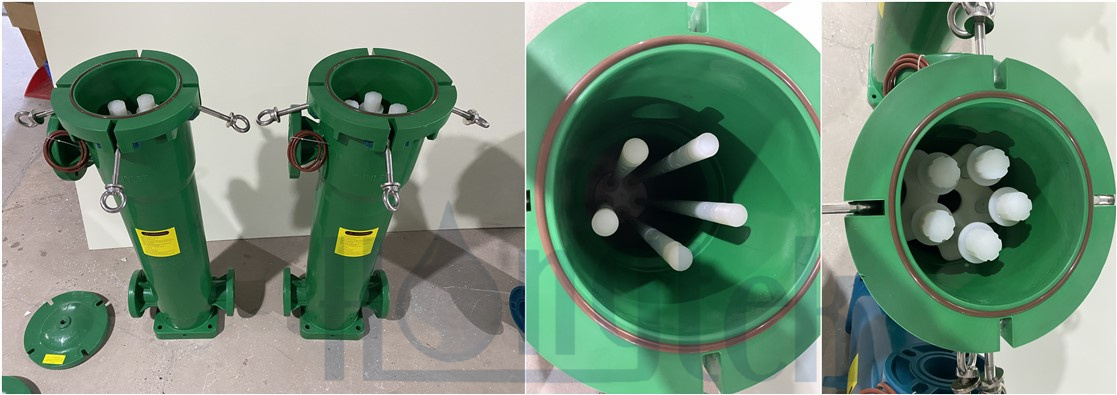
Hongtek's PPF Series PPH Plastic Multi Cartridge Filter Housing can withstand elevated temperatures over extended periods under normal operating conditions. For water-based media, continuous operation is possible up to 80°C, with intermittent peaks up to 90°C for short durations. This capability covers most industrial water treatment and chemical filtration applications where stainless steel is overkill and standard PP is inadequate.
3. Mechanical Strength Retention at High Temperatures
All thermoplastics experience some degree of strength reduction at elevated temperatures. PPH's advantage lies in its beta-crystal structure, which effectively slows this degradation process. At 80°C, PPH retains approximately 60-65% of its room-temperature strength, compared to only 40-45% for standard PP. Under identical temperature conditions, PPH demonstrates significantly better strength retention, ensuring adequate safety margins for typical operating pressures.
4. Long-Term Aging: A Critical Consideration
Short-term tolerance does not guarantee long-term reliability at high temperatures. Thermal aging - the gradual degradation of polymer chains over extended heat exposure - eventually reduces ductility. PPH service life depends on the combined effect of temperature level and actual operating hours. Higher temperatures generally result in shorter service life, so proper selection must balance expected equipment life with operating temperature.
5. The Combined Effect of Temperature and Corrosive Media
This represents the highest-risk blind spot in material selection. Temperature and chemical attack do not act independently - they amplify each other, often producing effects greater than the sum of their individual impacts. When corrosive media and high temperatures coexist, degradation can accelerate 2-3× faster than temperature alone. Selection requires simultaneous evaluation of both temperature and chemical media, rather than treating them as independent variables.

6. Three Key Principles for High-Temperature Selection
First, determine whether process temperature is continuous or intermittent, and how frequently peaks occur - continuous heat is more demanding on long-term aging. Second, always consult PPH performance data at actual operating temperatures rather than using room-temperature data; a housing rated for 10 bar at 23°C may only be safe for 6-8 bar at 80°C. Third, when corrosive media and high temperatures coexist, consider reducing the maximum operating temperature limit as a conservative safety margin.
Hongtek Filtration Co., Ltd.

Copyright © Hongtek Filtration Co., Ltd. All Rights Reserved | Sitemap